 Gold IRA Rollover Reviews








What Is a Gold IRA Rollover?
Bottom line: A gold IRA rollover lets you move retirement funds from a 401(k) or existing IRA into a self-directed IRA that holds physical gold, silver, platinum, or palladium — without triggering taxes or penalties when done correctly.
A gold IRA rollover moves funds from a 401(k), 403(b), 457(b), Thrift Savings Plan (TSP), traditional IRA, Roth IRA, SEP IRA, or SIMPLE IRA into a self-directed IRA that holds IRS-approved physical precious metals. Unlike conventional IRAs that are limited to stocks, bonds, and mutual funds, a gold IRA allows you to own tangible assets like gold bars, gold coins, and other IRS-approved precious metals within a tax-advantaged retirement account.
There are two types of rollovers: direct (trustee-to-trustee) transfers, where funds move between custodians without you touching the money, and indirect rollovers, where you receive the funds and must redeposit them within 60 days to avoid taxes and penalties. Financial advisors strongly recommend direct transfers to eliminate risk.
Top 5 Gold IRA Rollover Companies Compared
Between November 2025 and February 2026, we requested written fee schedules from 14 gold IRA providers, placed recorded discovery calls with each sales desk, and verified BBB, Trustpilot, and ConsumerAffairs ratings on March 14, 2026. Five providers passed all screens: verified A+ BBB, written fee schedule disclosed within 48 hours, no high-pressure upsell, and buyback spread under 5%.
- Augusta Precious Metals — Best overall. No fees for up to 10 years, $50,000 minimum, A+ BBB rating. Recognized by Forbes, Investopedia, and Money Magazine. Lifetime account support and price match guarantee. Known for exceptional customer education and one-on-one specialist support.
- Goldco — Best for first-time investors. $25,000 minimum, A+ BBB rating. Offers a streamlined setup process and excellent buyback program.
- Birch Gold Group — Best educational resources. $10,000 minimum, A+ BBB rating. Offers gold, silver, platinum, and palladium options with transparent fee structures.
- Noble Gold Investments — Best for accessible entry. Gold IRA minimum $20,000; cash-purchase Royal Survival Packs available from $2,000. A+ BBB rating, fast account setup, and Trustpilot verified.
- American Hartford Gold — Best buyback program. $10,000 minimum, A+ BBB rating. Price match guarantee and secure storage options.
Which Accounts Can You Roll Over Into a Gold IRA?
Any tax-advantaged employer or individual retirement account is eligible for a gold IRA rollover: 401(k), 403(b), 457(b), Thrift Savings Plan (TSP), traditional IRA, Roth IRA, SEP IRA, and SIMPLE IRA (after 2 years of participation). Rollovers from 401(k), 403(b), and TSP accounts are the most common. A direct trustee-to-trustee transfer is tax-free and not subject to the 60-day rollover deadline; an indirect rollover triggers a mandatory 20% withholding on 401(k) distributions, which you must cover out of pocket and recover when you file your return.
How the Gold IRA Rollover Process Works
The gold IRA rollover process follows five key steps, typically completed within 2-4 weeks:
- Choose a gold IRA company — Research providers based on fees, minimums, reputation, and the metals they offer. Request a free gold IRA kit for detailed information.
- Open your self-directed IRA — Complete the application with a qualified custodian. This requires basic personal information and ID verification (1-3 business days).
- Initiate the rollover — Your new custodian sends a trustee-to-trustee transfer request to your existing 401(k) or IRA provider. Direct transfers have no tax consequences.
- Select your precious metals — Work with your specialist to choose IRS-eligible gold (99.5% purity minimum), silver (99.9%), or platinum/palladium (99.95%). Popular choices include American Gold Eagles and Canadian Maple Leafs.
- Secure depository storage — Your Gold IRA company ships your metals directly to Delaware Depository, Brinks Global Services, or International Depository Services (IDS) — all IRS-approved facilities that insure holdings up to $1 billion. You receive storage confirmation and can verify holdings at any time.
IRS Rules and Requirements for Gold IRAs
The IRS imposes strict rules on gold IRAs that every investor must understand:
- Purity standards: Gold must be 99.5% pure, silver 99.9% pure, and platinum/palladium 99.95% pure.
- Approved storage only: The IRS requires a qualified depository — not your home safe — to store all Gold IRA metals, per Internal Revenue Code §408(m). Home storage is not permitted (see McNulty v. Commissioner, T.C. Memo. 2021-174).
- Custodian requirement: A qualified custodian such as Equity Trust Company or STRATA Trust Company must manage the account and handle IRS reporting.
- Contribution limits: The same annual contribution limits apply as traditional IRAs ($7,000 for 2026, or $8,000 if age 50+). Rollovers from existing accounts have no limit.
- 60-day rule: Indirect rollovers must be completed within 60 days, or the distribution becomes taxable income with potential 10% early withdrawal penalty.
Gold IRA Fees and Cost Breakdown (2026)
Typical gold IRA fees total $225–$500 in year one and $175–$350 annually thereafter: $50–$150 setup, $75–$300 custodian, $100–$200 storage, plus a spot price markup on metal purchases. Augusta Precious Metals waives all fees for up to 10 years on qualifying accounts. Segregated storage — where your exact bars are labeled with your name — costs $50–$100 more per year than commingled storage but provides full traceability.
- Setup fee: $50-$150 (one-time, waived by some companies)
- Annual custodian fee: $75-$300 per year
- Storage fee: $100-$200 per year (segregated storage costs more than commingled)
- Transaction/purchase fees: Varies by company, typically a percentage over spot price
- Wire transfer fee: $25-$50 per transaction
Augusta Precious Metals stands out by offering no fees for up to 10 years, making them the most cost-effective option for larger accounts despite their $50,000 minimum.
Pros and Cons of Gold IRA Rollovers
Advantages:
- Portfolio diversification beyond stocks and bonds
- Hedge against inflation — gold has historically preserved purchasing power
- Tax-advantaged growth within the IRA structure
- Physical asset ownership with tangible value
- Protection during economic downturns and market volatility
Disadvantages:
- Higher fees than traditional IRAs (storage and custodian costs)
- No dividend or interest income from metals
- Cannot store metals at home per IRS rules
- Potentially lower liquidity compared to stocks
- Gold prices can be volatile in the short term
- Required minimum distributions (RMDs) starting at age 73 may require selling metals or taking an in-kind distribution at current spot prices
IRA-Eligible Gold Coins and Bars
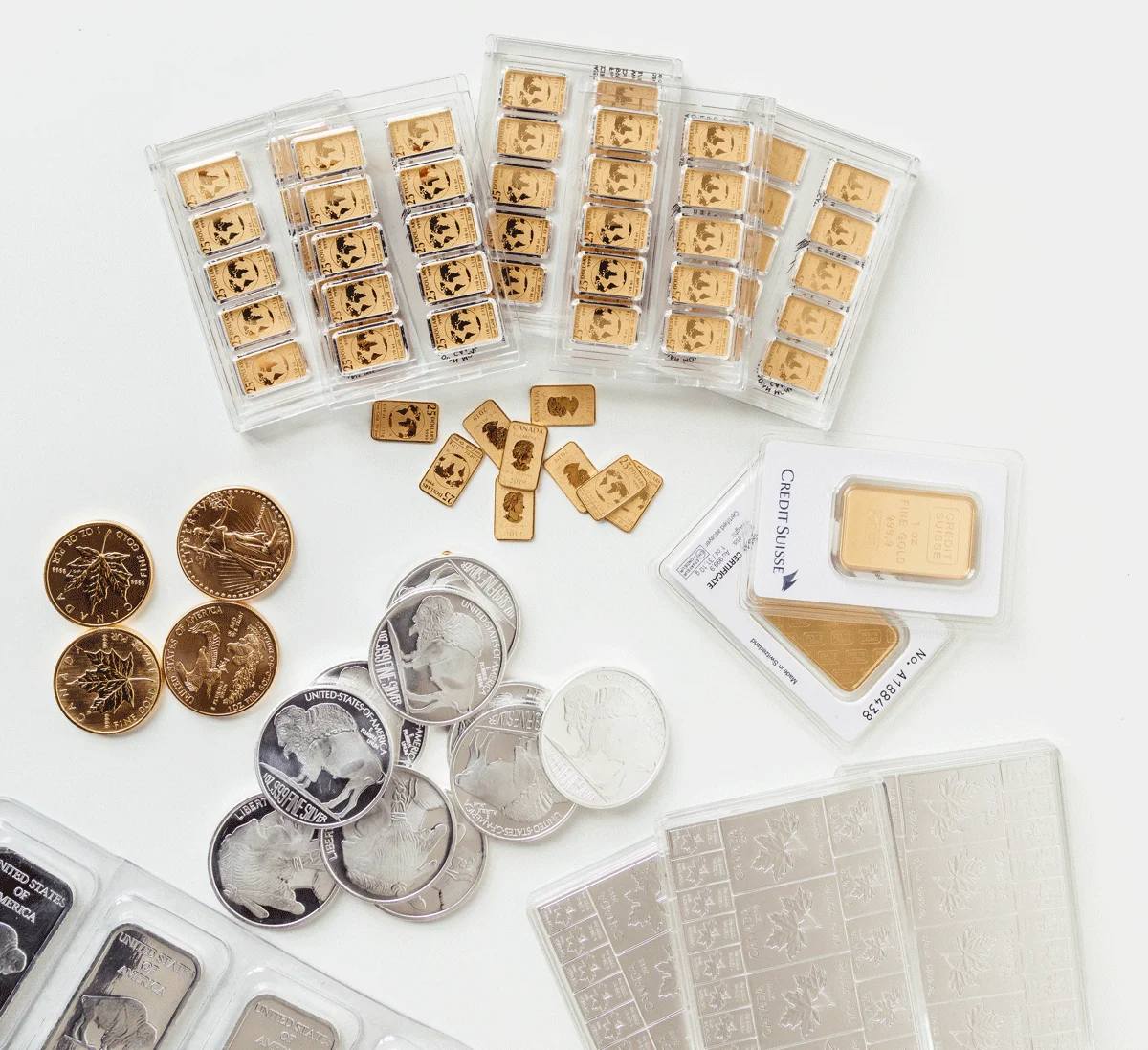
IRS-approved gold for a self-directed IRA must be at least .995 fine. Eligible products include: American Gold Eagle coins (exception to the .9167 fineness rule), American Gold Buffalo (.9999 fine), Canadian Gold Maple Leaf (.9999 fine), Austrian Gold Philharmonic (.9999 fine), and LBMA-approved bars from PAMP Suisse, Credit Suisse, and Valcambi. Proof coins must be in original mint packaging with a certificate of authenticity. Pre-1933 coins and collectibles are explicitly excluded per IRC §408(m).
How to Choose the Right Gold IRA Company
When evaluating gold IRA companies, prioritize these factors:
- BBB and BCA ratings — Look for A+ ratings from the Better Business Bureau and Business Consumer Alliance.
- Fee transparency — The company should clearly disclose all setup, annual, storage, and transaction fees upfront.
- Minimum investment — Match the minimum to your budget. Options range from $2,000 (Noble Gold) to $50,000 (Augusta).
- Customer education — Top companies provide free gold IRA kits, educational webinars, and dedicated specialists.
- Buyback policy — Confirm the company will repurchase your metals when you want to liquidate.
- Storage options — Verify they use IRS-approved depositories with segregated storage available.

Special Offer from Augusta Precious Metals
Augusta Precious Metals is America's #1 rated Gold IRA company. Get your FREE Gold IRA Kit today — no obligation, ships within 24-48 hours.
Request Your Free Gold IRA KitNo obligation | 100% Free | Ships in 24-48h
What Is a Gold IRA Rollover? A Complete Definition
A gold IRA rollover is the process of transferring funds from an existing retirement account — such as a 401(k), 403(b), TSP, or traditional IRA — into a self-directed Individual Retirement Account (SDIRA) that holds physical precious metals. Unlike a standard IRA invested in stocks or mutual funds, a gold IRA allows you to own IRS-approved gold bullion, coins, and other precious metals as part of your tax-advantaged retirement portfolio.
The term "rollover" refers specifically to moving money from one qualified retirement plan to another without triggering an immediate taxable event. The IRS permits these transfers under Section 408 of the Internal Revenue Code, provided you follow strict rules about timing, custody, and eligible assets. When done correctly, you preserve the tax-deferred (or tax-free, in the case of a Roth) status of your retirement savings while gaining exposure to physical gold.
Why Physical Gold — Not Paper Gold
It is important to distinguish a gold IRA rollover from simply buying gold ETFs or gold mining stocks inside a conventional brokerage IRA. A true gold IRA rollover puts physical, allocated metal — actual bars or coins you legally own — into the account. This matters because physical gold carries no counterparty risk: there is no corporate balance sheet, no derivative exposure, and no issuer that can default. In periods of financial stress, this distinction becomes critical for many investors.
Gold IRAs are classified as "alternative asset" IRAs and must be administered by a specialized custodian approved by the IRS. The custodian does not manage investments for you; instead, it handles all reporting, record-keeping, and compliance requirements while your chosen precious metals are stored in an IRS-approved depository.
- Eligible source accounts for a rollover include: 401(k), 403(b), 457(b), Thrift Savings Plan (TSP), SEP-IRA, SIMPLE IRA, traditional IRA, and Roth IRA
- The rollover can be direct (custodian-to-custodian) or indirect (funds sent to you, then re-deposited within 60 days)
- Direct rollovers are strongly preferred — they eliminate withholding tax risk and the 60-day deadline
- There is no limit on the dollar amount you can roll over from an employer plan
- You can roll over a portion of your existing account — you do not have to move the full balance
Gold IRA rollovers have grown significantly in popularity since the 2008 financial crisis, with another surge following the inflation spike of 2021-2023. Investors seeking to hedge against dollar devaluation, equity market volatility, and geopolitical uncertainty have increasingly turned to precious metals as a diversification tool within their tax-sheltered retirement accounts.
How a Gold IRA Rollover Works: Step-by-Step Process
Understanding the mechanics of a gold IRA rollover is essential before you commit any retirement savings. The process involves three key parties: your existing plan administrator, a new self-directed IRA custodian, and an IRS-approved precious metals depository. Here is exactly how the process unfolds from start to finish.
Step 1: Choose a Self-Directed IRA Custodian
Your first step is selecting a custodian authorized to hold alternative assets. Not all IRA custodians accept physical gold. Look for companies that specialize in self-directed IRAs and have a clear fee schedule. Popular custodians used by gold IRA companies include Equity Trust Company, Goldstar Trust, and Kingdom Trust. Setup fees typically range from $50 to $150, and annual maintenance fees run $75 to $300 per year.
Step 2: Open Your New Gold IRA Account
Once you have selected a custodian, you complete an account application, provide identity verification documents, and designate beneficiaries. This step usually takes one to three business days. Many gold IRA companies act as dealers and facilitate this entire process, helping you coordinate paperwork with the custodian on your behalf.
Step 3: Initiate the Rollover or Transfer
Contact your current plan administrator and request a direct rollover (also called a trustee-to-trustee transfer). The funds move directly from your existing account into your new gold IRA without ever touching your bank account. This avoids the mandatory 20% withholding tax that applies to indirect rollovers and eliminates the risk of missing the 60-day re-deposit window. Most transfers complete within 5 to 15 business days, though some 401(k) plans can take up to 30 days.
Step 4: Select Your Precious Metals
Once funds arrive in your new SDIRA, you direct the custodian to purchase IRS-approved precious metals from a licensed dealer. The metals must meet specific fineness standards: gold must be at least 99.5% pure (0.995 fineness), silver 99.9%, platinum 99.95%, and palladium 99.95%. Common eligible products include American Gold Eagles, Canadian Gold Maple Leafs, American Gold Buffalos, and PAMP Suisse gold bars.
Step 5: Arrange Secure Storage
The IRS strictly prohibits storing gold IRA assets at home or in a personal safe deposit box. All metals must be held in an IRS-approved, third-party depository. Major depositories include Brinks Global Services, Delaware Depository Service Company (DDSC), International Depository Services (IDS), and CNT Depository. You choose between segregated storage (your metals stored separately, identified as yours specifically) at $150–$300 per year, or commingled storage (pooled with other clients' metals of the same type) at $100–$175 per year.
- Total timeline from decision to metals in vault: typically 2 to 4 weeks
- Direct rollovers have no tax consequences when executed correctly
- You may roll over funds from multiple source accounts into a single gold IRA
- After the rollover, you can continue making annual contributions up to IRS limits
- You will receive annual statements from both the custodian and the depository
IRS Rules and Regulations for Gold IRAs in 2026
The IRS imposes specific requirements on gold IRAs that differ significantly from standard retirement accounts. Failing to follow these rules can result in the entire account being treated as a taxable distribution, plus a 10% early withdrawal penalty if you are under age 59½. Knowing the regulations in detail is not optional — it is essential to preserving the tax advantages you are trying to capture.
2026 Contribution Limits
For 2026, the IRS annual contribution limit for a gold IRA (which follows traditional or Roth IRA rules, depending on how your account is structured) is $7,000 per year. Investors aged 50 or older qualify for an additional catch-up contribution of $1,000, bringing the maximum annual contribution to $8,000. These limits apply to contributions only — rollovers from eligible employer plans have no dollar ceiling.
Eligible Precious Metals Under IRS Code Section 408(m)
The IRS specifies that gold held in an IRA must meet a minimum fineness of 99.5% (0.9950). The only exception is the American Gold Eagle coin, which is 91.67% gold (22 karat) but is explicitly approved by statute. Silver must be 99.9% fine, platinum 99.95% fine, and palladium 99.95% fine. Collectible coins, numismatic coins, and bullion that does not meet these purity thresholds are not permitted and would constitute a prohibited transaction.
- IRS-approved gold coins: American Gold Eagle (1 oz, 1/2 oz, 1/4 oz, 1/10 oz), American Gold Buffalo (0.9999 fine), Canadian Gold Maple Leaf (0.9999 fine), Australian Gold Kangaroo/Nugget, Austrian Gold Philharmonic
- IRS-approved gold bars: Any bar produced by a NYMEX/COMEX-approved or ISO-9001 certified refiner, minimum 0.995 fineness — including PAMP Suisse, Valcambi, Credit Suisse, and Engelhard bars
- NOT eligible: South African Krugerrands (only 91.67% gold but not explicitly approved like the Eagle), most pre-1933 U.S. gold coins, all numismatics
- Collectibles rule: Under IRC 408(m), acquisition of a collectible by an IRA is treated as a distribution equal to the cost of the collectible
The Home Storage Rule: A Critical Warning
Some gold IRA marketing materials promote "home storage" or "checkbook IRA" strategies that claim to allow you to keep physical gold at your residence. The IRS and U.S. Tax Court have consistently ruled against these arrangements. Storing IRA-owned gold at home constitutes a distribution, making the entire value immediately taxable as ordinary income plus the 10% early withdrawal penalty. The IRS has issued multiple guidance letters and court decisions reinforcing this position. Do not risk your retirement savings on these schemes.
Required Minimum Distributions (RMDs)
Traditional gold IRAs are subject to Required Minimum Distributions beginning at age 73 (as of the SECURE 2.0 Act). Because gold is a physical asset, you must either sell enough metal to satisfy your RMD in cash, or take an "in-kind" distribution where the depository ships you the equivalent value of metal. In-kind distributions are taxable at fair market value on the distribution date, and standard income tax rates apply. Roth gold IRAs have no RMDs during the account owner's lifetime.
Gold IRA Fees and Costs: What You Will Actually Pay
Transparency on fees is one of the most important factors when evaluating gold IRA companies. Unlike stock brokerage accounts where expense ratios are fractions of a percent, gold IRA investing involves multiple layers of fees. Understanding the full cost structure upfront prevents unpleasant surprises and allows you to make accurate comparisons between providers.
One-Time Setup and Account Fees
Most gold IRA custodians charge a one-time account setup fee ranging from $50 to $150. Some gold IRA dealers waive or cover this fee as an incentive for new customers. Additionally, if a rollover requires processing wire transfers or expedited handling, you may encounter transaction fees of $25 to $50 per wire. These are relatively minor compared to ongoing costs, but they should be disclosed upfront.
Annual Custodian and Administrative Fees
Annual custodian fees cover account maintenance, IRS reporting (Form 5498 and Form 1099-R), and compliance oversight. These typically run $75 to $300 per year, depending on the custodian and account value. Some custodians charge flat fees; others charge a percentage of assets under custody (typically 0.25% to 0.5% annually). Flat-fee structures generally favor investors with larger account balances.
Storage Fees
Storage fees are paid to the depository, not the custodian, and are charged annually. Segregated storage — where your specific metals are stored in a separate, individually identified vault space — costs $150 to $300 per year at most major depositories. Commingled (non-segregated) storage typically costs $100 to $175 per year. Most financial advisors recommend segregated storage despite the higher cost, as it provides clearer documentation of your specific holdings and avoids any ambiguity in a depository insolvency scenario.
Dealer Markups on Precious Metals
Perhaps the largest and least-discussed cost is the dealer markup over spot price. When you purchase gold through a gold IRA company, you pay more than the current market (spot) price. For standard bullion products like American Gold Eagles or major gold bars, a fair markup is 3% to 5% over spot. However, some dealers charge 10% to 33% or more on "premium" or "exclusive" coins — products not available on the secondary market — making them nearly impossible to sell later at a fair price. Always ask the dealer for the exact price you will pay and calculate the markup versus that day's spot price before committing.
- Setup fee: $50–$150 (one-time)
- Annual custodian/admin fee: $75–$300/year
- Annual storage fee (segregated): $150–$300/year
- Annual storage fee (commingled): $100–$175/year
- Dealer markup on standard bullion: 3%–5% over spot
- Dealer markup on premium/numismatic coins: 10%–33%+ over spot (avoid these)
- Wire transfer fee: $25–$50 per transaction
- Liquidation fee: $0–$50 per transaction when you sell
For a $100,000 gold IRA, a reasonable total annual cost estimate is approximately $400 to $600 per year in custodian and storage fees, plus the initial dealer markup at purchase. Over 10 years, total fees might represent 4% to 6% of your original investment in fixed costs alone. This is higher than a stock index fund but consistent with other alternative asset vehicles, and the potential inflation hedge benefit is the tradeoff investors accept.
Pros and Cons of a Gold IRA Rollover
A gold IRA rollover is not the right move for every investor. Like any financial product, it has genuine advantages and real limitations. Evaluating both sides with clear-eyed honesty is the only way to determine whether this strategy aligns with your retirement goals, time horizon, and risk tolerance.
Advantages of a Gold IRA Rollover
- Inflation hedge: Gold has historically preserved purchasing power over long time periods. During the 1970s stagflation, gold prices rose from $35 to over $800 per ounce. During the post-COVID inflation surge (2020-2022), gold maintained its value while real returns on bonds turned deeply negative
- Portfolio diversification: Gold's correlation to U.S. equities has historically been near zero or slightly negative, meaning gold often rises when stocks fall — a valuable characteristic during market downturns
- No counterparty risk: Physical gold has no issuer, no corporate balance sheet, and no reliance on any third party's ability to pay — unlike bonds, bank deposits, or paper currency
- Tax advantages preserved: A properly executed rollover maintains tax-deferred (traditional) or tax-free (Roth) status, so gold's gains are not taxed annually
- Protection from currency debasement: As central banks increase money supply, gold's fixed physical supply has historically made it a store of value against fiat currency erosion
- Global safe-haven demand: Gold is accepted and valued in every country, providing true currency-agnostic wealth preservation
Disadvantages and Risks of a Gold IRA Rollover
- No yield or income: Gold pays no dividends, interest, or rental income. All return comes from price appreciation, meaning you are entirely dependent on price movement
- Higher fees than traditional IRAs: The combination of custodian fees, storage fees, and dealer markups makes gold IRAs more expensive than stock or bond index fund IRAs, which can have total annual costs below 0.10%
- Price volatility: Gold can experience sharp short-term corrections. In 2013, gold fell 28% in a single year. Investors who need liquidity during a downturn may lock in significant losses
- Dealer fraud and high-pressure sales risk: The gold IRA industry has attracted bad actors who use high-pressure sales tactics, misrepresent fees, or push numismatic coins with massive markups. Due diligence is critical
- Liquidity limitations: Selling physical gold from an IRA requires contacting the custodian, finding a buyer at a fair price, and waiting for settlement — a slower process than selling stocks online
- No FDIC or SIPC protection: Physical gold in a depository is not insured by any government agency, though depositories carry their own private insurance policies
- Concentration risk: Overallocating to gold (more than 15-20% of a portfolio) may reduce long-term returns compared to a diversified stock and bond portfolio
Most financial planners suggest allocating no more than 5% to 15% of your retirement portfolio to precious metals, treating gold as a diversifier rather than a core holding. This approach captures the inflation-hedging and diversification benefits while limiting exposure to gold's price volatility and fee drag.
Top Gold IRA Companies Reviewed for 2026
Choosing the right gold IRA company is arguably the most consequential decision in this entire process. The company you select will guide your rollover, source your metals, coordinate with your custodian, and determine whether you pay fair prices for your bullion. We have evaluated the leading companies on transparency, fee structure, product selection, customer service, and regulatory standing.
Augusta Precious Metals
Augusta Precious Metals consistently ranks as one of the most transparent and customer-focused companies in the gold IRA space. They require a $50,000 minimum investment, which positions them for serious retirement savers rather than beginners. Augusta charges a flat $200 annual fee (custodian plus storage combined) for the first year and $180 annually thereafter, making their cost structure genuinely competitive for accounts above $100,000. They are known for their extensive educational resources and a mandatory one-on-one web conference with a licensed economist before account opening — a practice that helps ensure informed decisions. Augusta has an A+ rating with the Better Business Bureau (BBB) and a near-perfect 4.9/5 score on Trustpilot across thousands of reviews.
Goldco Precious Metals
Goldco is one of the most recognized names in the industry, with over a decade of operation and more than $2 billion in precious metals placements. Their minimum investment is $25,000, and they offer both gold and silver IRAs. Goldco charges a $50 setup fee, $80/year custodian fee, and $100/year storage fee, putting their baseline ongoing cost at approximately $180 per year before any markup on metals. They work with Equity Trust as their primary custodian and Brinks or Delaware Depository for storage. Goldco earned the Inc. 5000 designation and holds an A+ BBB rating. They offer a "BuyBack Guarantee," committing to repurchase your metals when you decide to liquidate.
American Hartford Gold
American Hartford Gold has a lower $10,000 minimum, making it accessible for investors just beginning to add precious metals to their retirement portfolio. They waive setup and first-year storage fees for qualifying accounts and offer price-match guarantees on gold and silver purchases. Their custodian partner is Equity Trust, and they use the Delaware Depository or Brinks for storage. American Hartford holds an A+ BBB rating and is regularly ranked among the top gold IRA companies on Forbes and Investopedia.
Birch Gold Group
Birch Gold Group has been operating since 2003 and maintains a strong reputation for customer education. They offer a $10,000 minimum and work with custodians including Equity Trust and Goldstar Trust. Their fee structure includes a $50 setup fee, $100 annual custodian fee, and $100 annual storage fee. Birch Gold is known for offering a broader range of precious metals products including platinum and palladium IRAs in addition to gold and silver. They carry an A+ BBB rating and have been endorsed by several prominent conservative media personalities.
- Key criteria when comparing gold IRA companies: fee transparency (request complete written fee schedule before signing anything), BBB rating and complaint history, years in business, minimum investment requirements, buyback policy and liquidation process, storage options (segregated vs. commingled), custodian partners used, and response time on customer service inquiries
Tax Rules for Gold IRA Rollovers: What You Owe and When
Tax treatment is one of the primary reasons investors choose to roll existing retirement assets into a gold IRA rather than simply buying gold in a taxable brokerage account. Understanding the tax rules fully — including how distributions are taxed, how rollovers are reported, and what triggers penalties — is critical to making the strategy work as intended.
Tax Treatment of the Rollover Itself
A direct rollover from a 401(k) or existing IRA to a gold IRA is a non-taxable event when properly executed. The IRS requires your plan administrator to report the distribution on Form 1099-R, but the transaction is coded as a rollover (Code G for direct rollovers from employer plans, Code 0 for transfers). You report the transaction on your Form 1040 using Form 8606 if applicable, but no tax is owed and no penalty applies. An indirect rollover — where funds come to you first — is reported the same way, but only if you re-deposit the full amount (including any 20% withheld by your employer) within 60 calendar days.
Traditional Gold IRA: Tax-Deferred Growth
A traditional gold IRA funded with pre-tax dollars (rolled over from a traditional 401(k) or traditional IRA) grows tax-deferred. You pay no tax on appreciation while the gold remains in the account. When you take distributions in retirement, withdrawals are taxed as ordinary income at your marginal federal tax rate — the same treatment as any traditional IRA or 401(k) distribution. If gold has appreciated substantially, the entire gain is taxed as ordinary income (currently up to 37% at the top federal bracket), not at the lower long-term capital gains rate that applies to gold held in a taxable account for more than one year.
Roth Gold IRA: Tax-Free Growth
A Roth gold IRA is funded with after-tax dollars. If you roll a Roth 401(k) into a Roth gold IRA, or convert a traditional account to a Roth gold IRA (paying tax at conversion), all future growth and qualified distributions are completely tax-free. Given gold's potential for significant long-term appreciation, a Roth gold IRA can be particularly powerful for investors who expect to be in a higher tax bracket in retirement or want to leave tax-free assets to heirs. The Roth conversion amount is taxable in the year of conversion — consult a tax professional before converting large balances.
Early Withdrawal Penalties
Withdrawing funds from a traditional gold IRA before age 59½ triggers a 10% early withdrawal penalty in addition to ordinary income tax on the amount withdrawn. The same exceptions that apply to traditional IRAs apply here: disability, substantially equal periodic payments (SEPP/72(t) elections), first-time home purchase (up to $10,000 lifetime), higher education expenses, and certain medical expenses. The penalty does not apply to Roth gold IRA contributions (though it may apply to earnings withdrawn early).
- RMDs begin at age 73 for traditional gold IRAs (no RMDs during owner's lifetime for Roth gold IRAs)
- Failing to take RMDs results in a 25% excise tax on the amount that should have been distributed (reduced to 10% if corrected within 2 years)
- In-kind RMD distributions (receiving physical gold instead of cash) are taxable at fair market value on distribution date
- Gold IRA gains in taxable accounts face a 28% federal collectibles rate — a key advantage of the IRA structure avoiding this rate
- State income taxes also apply to traditional IRA distributions in most states
Gold IRA vs. Other Precious Metals Investment Options
Before committing to a gold IRA rollover, it is worth understanding how it compares to other ways of gaining gold exposure. Each approach has distinct tax implications, costs, liquidity profiles, and practical considerations. The right choice depends on whether your primary goal is tax-advantaged retirement savings, liquidity, or direct physical ownership.
Gold IRA vs. Physical Gold in a Taxable Account
Buying physical gold outside of an IRA — gold bars or coins held personally — gives you direct possession and maximum liquidity. However, gains from selling physical gold are subject to the IRS "collectibles" tax rate of 28% on long-term capital gains (higher than the 15-20% long-term capital gains rate on stocks). Short-term gains are taxed as ordinary income. There are no annual fees for self-stored gold, but you bear full insurance and security costs yourself. A gold IRA avoids the 28% collectibles rate on gains while in the account, which can be a substantial tax savings for large positions with significant appreciation.
Gold IRA vs. Gold ETFs (GLD, IAU)
Gold ETFs like SPDR Gold Shares (GLD) and iShares Gold Trust (IAU) can be held inside a standard IRA or 401(k) without opening a separate self-directed account. GLD charges an annual expense ratio of 0.40% and IAU charges 0.25% — far lower than the combined custodian and storage fees of a physical gold IRA. The major tradeoff: ETF shares represent fractional ownership of gold held in trust, not direct physical ownership. In a severe financial crisis or custodial failure, ETF shareholders may face delays or losses. Physical gold IRA holders own allocated metal with direct legal claim to specific bars or coins. For most investors in stable markets, ETFs are more cost-effective; for investors primarily concerned with counterparty and systemic risk, physical gold IRAs provide greater protection.
Gold IRA vs. Gold Mining Stocks
Gold mining stocks (individual companies like Barrick Gold, Newmont, or Agnico Eagle) and gold mining ETFs (GDX, GDXJ) offer leveraged exposure to gold prices — mining stocks often rise 2-3x as much as the gold price in bull markets. However, they also carry company-specific risks: management quality, geopolitical risk in mining regions, production costs, environmental liabilities, and operational execution. Mining stocks can fall even when gold prices rise if a company has problems. They are equity instruments, not commodities, so they are taxed at standard capital gains rates and can be held in any standard IRA. A gold IRA provides direct gold price exposure without equity risk, at the cost of higher fees and lower potential leverage.
- For maximum tax efficiency with low cost: Gold ETFs (GLD/IAU) in existing Roth IRA
- For true physical ownership with tax deferral: Gold IRA with segregated storage
- For counterparty-risk-free physical ownership with full liquidity: Personal physical gold (subject to 28% collectibles rate)
- For leveraged exposure to gold price: Gold mining stocks or GDX/GDXJ (equity risk applies)
- For hands-off diversification: A balanced mutual fund or ETF that includes commodity exposure alongside equities
How to Choose the Right Gold IRA Company: Red Flags and Green Lights
The gold IRA industry has produced some exceptional companies with decades of integrity — and it has also attracted opportunistic actors who use misleading advertising, high-pressure sales tactics, and opaque pricing to exploit investors. Learning to distinguish the two is one of the most valuable things you can do before moving a single dollar of your retirement savings.
Green Lights: Signs of a Reputable Company
- Full fee disclosure upfront: A trustworthy company will provide a complete written fee schedule before you open an account — setup fees, annual custodian fees, storage fees, and typical dealer markups all disclosed clearly
- A+ BBB rating with few unresolved complaints: Check BBB.org directly, not just a company's own website. Look for the pattern and resolution of complaints, not just the rating
- 5+ years in business with verifiable history: Longevity matters. Companies that have survived multiple market cycles (2008, 2013, 2020, 2022) have demonstrated staying power
- Physical address, licensed staff, and verifiable legal entity: Confirm the company is a registered business entity in its home state
- Educational resources without pressure: Reputable companies provide information and encourage questions without rushing you to sign
- Buyback program with transparent pricing: A buyback guarantee at or near current market rates shows confidence in their products
Red Flags: Warning Signs to Avoid
- "Home storage IRA" promotions: As detailed earlier, these are legally problematic and can cost you your entire retirement tax benefit
- Numismatic or "exclusive" coin recommendations: If a salesperson steers you toward rare or collectible coins priced at 20-50%+ over spot, walk away. These serve the dealer's profit margin, not your retirement
- High-pressure tactics or artificial urgency: Phrases like "gold prices spike tomorrow" or "this offer expires in 24 hours" are manipulation tactics, not legitimate investment guidance
- Vague or verbal-only fee disclosures: If a company won't put fees in writing before you sign, assume they are hiding something
- Promises of guaranteed returns or "safe" investing: Gold prices fluctuate significantly. Any company claiming guaranteed profits is violating securities law
- Unlicensed or unverifiable custodians: Verify that your custodian is chartered and regulated — legitimate custodians are regulated by state banking authorities or the OCC
The Consumer Financial Protection Bureau (CFPB) and FINRA both publish investor alerts about precious metals fraud. Before choosing any gold IRA company, take 30 minutes to read these resources and search the CFPB complaint database for the company name. The Federal Trade Commission (FTC) has also taken enforcement action against multiple gold IRA dealers for deceptive pricing and misleading advertising. Your due diligence is your best protection.
Gold IRA Rollover Frequently Asked Questions
Can I roll my 401(k) into a gold IRA without penalty?
Yes, provided you execute a direct rollover (trustee-to-trustee transfer) and the funds never pass through your hands. A direct rollover from a 401(k) to a self-directed gold IRA is a non-taxable, non-penalty event regardless of your age. The indirect rollover option (funds sent to you, then deposited within 60 days) is also penalty-free if completed on time, but your employer must withhold 20% for taxes, which you must replace from your own funds and reclaim on your tax return — making direct rollovers strongly preferable.
How much of my retirement savings should I put in gold?
Most financial planners suggest allocating 5% to 15% of a retirement portfolio to precious metals as a diversification and inflation hedge. The exact percentage depends on your age, risk tolerance, existing asset allocation, and macroeconomic outlook. Younger investors with long time horizons may benefit from a smaller allocation since equities have historically outperformed gold over long periods. Investors closer to or in retirement may value gold's stability more highly. Concentrating more than 20% in any single asset class — including gold — is generally considered excessive concentration.
How long does a gold IRA rollover take?
The full process — from opening your gold IRA account to having physical metals secured in a depository — typically takes 2 to 4 weeks. Account opening takes 1 to 3 business days. The transfer of funds from your existing account usually takes 5 to 15 business days, though some 401(k) plan administrators require up to 30 days. Metal purchases and delivery to the depository take an additional 3 to 7 business days after funds arrive.
Can I take physical delivery of my gold?
Yes, but it is treated as a taxable distribution. If you are under 59½, you also owe the 10% early withdrawal penalty. The IRS does not permit IRA gold to be stored at your residence while the account remains active. You can, however, close your gold IRA and take physical delivery of the metals as an in-kind distribution — you own the metal outright after paying applicable taxes, and you can store it however you choose afterward.
What happens to my gold IRA if the company goes bankrupt?
Your metals are legally yours — they are titled in your name (not the dealer's or custodian's balance sheet) and held at a third-party depository. If your gold IRA company (the dealer) goes bankrupt, it does not affect your metals, because the dealer never holds them. If your custodian were to fail, the depository holds your metals in trust; a replacement custodian is appointed and operations continue. The primary risk is if your depository fails, which is why major depositories like Brinks, DDSC, and IDS carry substantial private insurance policies (typically $1 billion or more in coverage) and are subject to regular third-party audits.
Is a gold IRA right for someone already in retirement?
It can be, but with important caveats. Retirees must account for Required Minimum Distributions (RMDs) beginning at age 73. Gold's price volatility means that an RMD year could coincide with a gold price decline, forcing you to liquidate metal at a lower price than desired. Retirees with multiple income sources and no urgent need to liquidate gold holdings may find it a useful inflation hedge. However, retirees heavily dependent on their IRA for living expenses should maintain sufficient liquid assets (cash, bonds, dividend stocks) to cover several years of spending without needing to sell gold during an unfavorable market.
 Our Editorial Team